Wagr
Designing a Smarter Petcare Ecosystem



Building More Than Just Another Pet App
Wagr started as a GPS tracking solution designed to help pet parents keep their dogs safe. While the product solved an important problem, tracking represented only a small part of the pet parenting journey.
Rather than continuing to build around hardware, Wagr saw an opportunity to become a digital-first petcare platform that could support pet parents through every stage of their journey.
Research revealed that pet parents faced three recurring challenges.
Accessing trusted veterinary care often involved long wait times, travel, or limited availability.
Everyday petcare was fragmented across multiple apps, websites and communities.
Most products were reactive, requiring users to search for information instead of providing timely guidance.
This presented an opportunity to build a platform that simplified petcare through trusted, connected and personalised experiences.
Shaping the Product Roadmap
Beyond designing interfaces, I worked closely with the founders to prioritise features and establish scalable design patterns that could support the platform as it evolved.
Across three product phases, my work spanned research, product strategy, interaction design, visual design, prototyping, and building a flexible design system that could accommodate future growth.


Why We Built in Phases
Wagr had a broader ambition to solve more of the pet parenting journey, but what that would look like wasn't defined upfront. Over three years, the product evolved as we learned from users and the needs of the business changed.
Each release opened up new opportunities: from validating digital veterinary care, to creating more reasons for users to return, to introducing new revenue streams and more personalised experiences. What now looks like three distinct phases was really the result of learning, adapting, and expanding the product over time.
Phase 1:
Building Trust Through Digital Healthcare
The first product investment focused on solving one of the biggest challenges for pet parents: access to trusted veterinary care. Introducing TeleVet consultations allowed Wagr to establish credibility, reduce friction in accessing professional advice, and validate digital healthcare as the platform's entry point.

Structured the experience around the pet’s concern
Pet parents came in with a problem, not a doctor in mind. We structured the consultation journey around common concerns, allowing users to select an issue, share relevant details, and move into a consultation without first figuring out what service or vet they needed.

Made instant consultations truly instant
Most TeleVet consultations were instant, with pet parents looking for advice quickly. Instead of asking users to compare doctors, we matched them with the next available top vet across India, typically within 15–30 minutes. Doctor profiles were surfaced after booking and payment, reducing decisions and drop-off while still providing transparency before the consultation.
If users weren't comfortable with the assigned vet, they could request another and we'd match them with the next available vet.

Designed continuity beyond the consultation
The experience extended beyond the video call, giving pet parents a detailed record of what happened during each consultation. Doctor's notes brought together the diagnosis, recommendations and prescriptions, with past prescriptions retained for reference and downloadable when needed. This gave users one place to return to for everything related to that consultation as they continued their pet's care.
Phase 2:
Expanding Into Everyday Petcare
As Wagr evolved beyond TeleVet, the business began exploring more ways to support pet parents beyond moments of illness, while also opening up new avenues for engagement and revenue.
This brought commerce, everyday guidance, learning and other petcare services into the product. The design challenge shifted from solving a single journey to making an expanding set of offerings feel like one coherent Wagr experience.

Making guidance proactive
Toto was designed as more than a question-and-answer chatbot. After responding to a query, we used the conversation as an opportunity to surface relevant follow-ups, routines and preventive-care nudges, rather than ending the interaction at the answer. This made the experience feel continuous while giving users useful next steps without requiring them to know what to ask next.

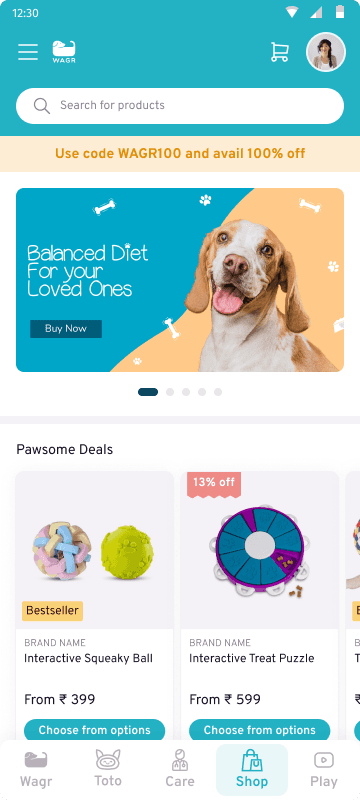
Bringing shopping into the care journey
Shop remained a dedicated space where users could browse and discover products independently. But when a conversation with Toto revealed a relevant need, we would surface product recommendations directly in context, using the pet’s profile and the conversation to narrow the options. This created a more natural bridge between guidance and commerce without making shopping dependent on the chatbot.

Making it easy to ask before it becomes urgent
Not every petcare question needed the same depth of interaction. We designed lightweight entry points for quick questions alongside more detailed, expert-led content for users who wanted to understand a topic further. This let users move from asking → getting a quick answer → learning more without forcing everyone through the same experience.

Turning scattered records into one pet history
As Wagr expanded, pet information risked becoming fragmented across consultations, uploaded documents and different parts of the app. We consolidated these into the pet profile, with health records automatically carrying over from relevant interactions while still allowing users to add their own documents. This created one consistent care history for the user and gave other Wagr experiences a common source of pet context.
Phase 3:
Creating a More Intelligent Product
By this point, Wagr had grown into a broader petcare ecosystem and had richer context about each pet across their profile, health records and interactions.
The next opportunity was to make that context useful: instead of expecting pet parents to repeatedly search for information or remember routine care themselves, Wagr could begin surfacing more relevant guidance based on who their pet was and what they might need next.

Turned life stage into a dynamic care plan
We used the pet’s life stage as more than a personalisation label. It became a framework for organising what the pet parent needed to know and do at that point in their pet’s life, from training and activity needs to preventive health and common concerns. The home experience surfaced these as timely, actionable modules, allowing the guidance to evolve as the pet moved from one life stage to the next.

Made recommendations explain themselves
Personalised guidance can feel arbitrary if users don't understand why they're seeing it. So recommendations weren't presented as isolated nudges: we gave users enough context to understand why something was relevant to their pet, along with a clear next step or the option to learn more. This was especially important for preventive care, where the need isn't always obvious or urgent.
Designing AI as an assistant, not a replacement
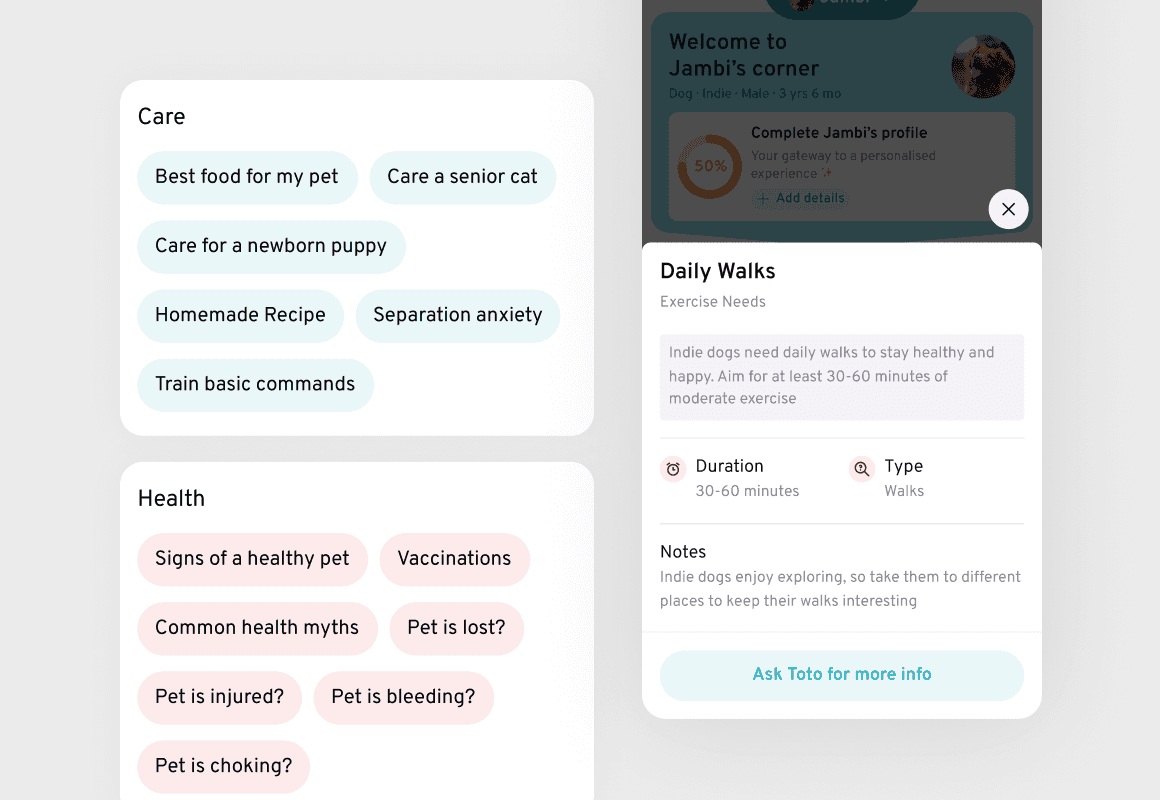
We used suggested prompts to help users understand what they could ask Toto, rather than expecting them to start with an empty chat. Answers could then use the pet's existing context and let users progressively go deeper, from a quick recommendation to more detailed guidance or a related action. For health concerns, that journey still had a clear boundary: AI could guide and inform, but professional care remained the escalation path when needed.
Key Learnings
By validating trust through healthcare before expanding into everyday petcare and personalisation, the product was able to evolve naturally while maintaining a cohesive experience for users.
Designing Wagr reinforced that successful products aren't built by shipping more features—they're built by solving the right problems at the right time.
Designing for Scale
One of the biggest design challenges wasn't solving today's problems—it was ensuring today's solutions wouldn't limit tomorrow's product direction. Navigation, information architecture, design systems, and interaction patterns were intentionally designed to accommodate future services without requiring major redesigns.
There’s more to the story than what’s on this page. Reach out at anjalidarbha.work@gmail.com if you’d like to see the full case study.